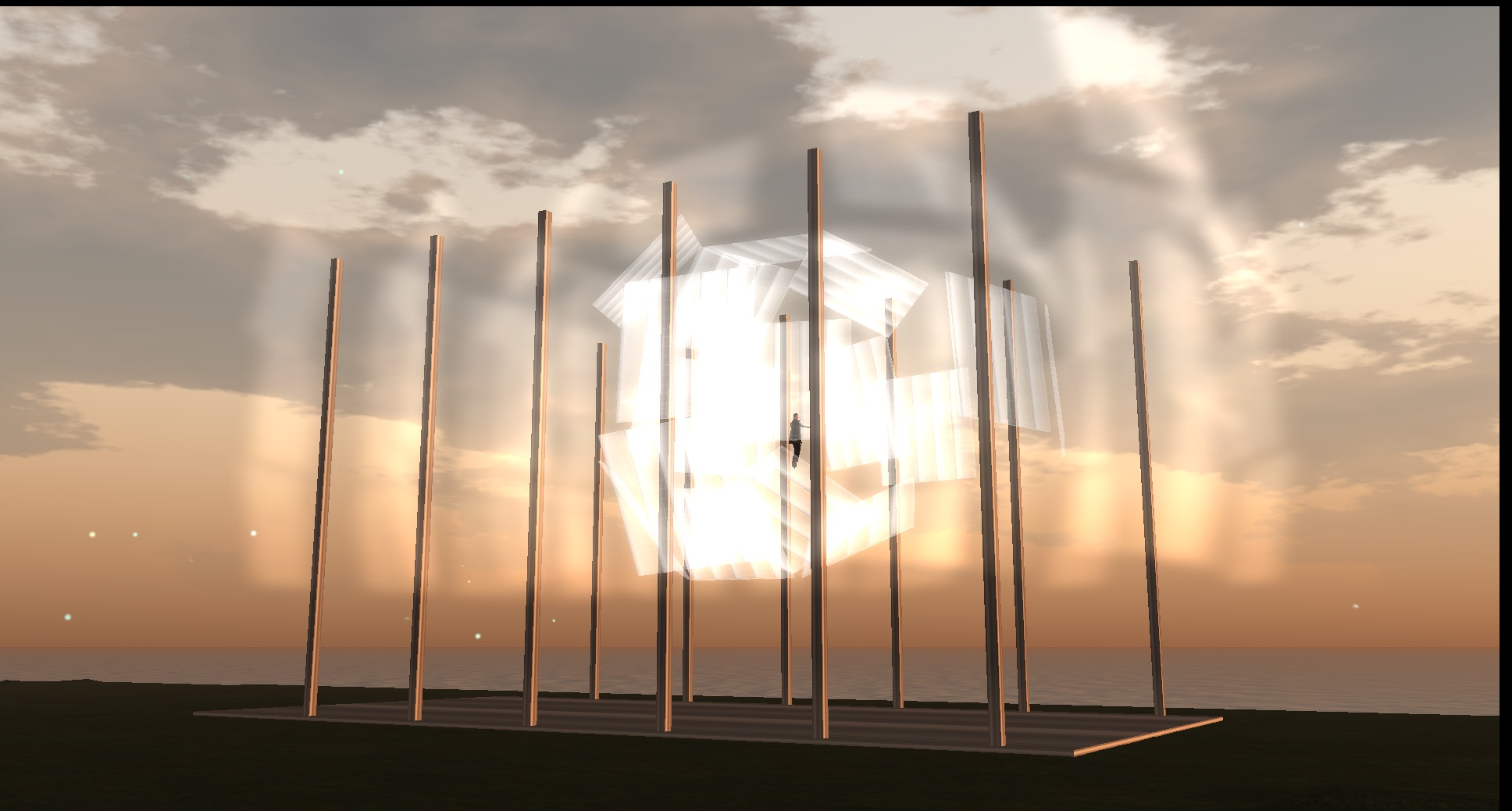
I logged into Second Life late last night and hammered out a quick machinima shown above – as a kind of outburst reaction to having spent the evening noodling through the classic texts on architecture in cyberspace – most of which were written 20 years ago, at a time when the current fidelity and rich, vibrant life of 3D online environment we enjoy today could only be imagined.
It is almost as if the very lack of ‘cyberspace,’ (as they most often called it back then) drove them to a conceptual clarity that remains as clear and true today as it was when it was published. But where are these theorists of architecture in cyberspace now?
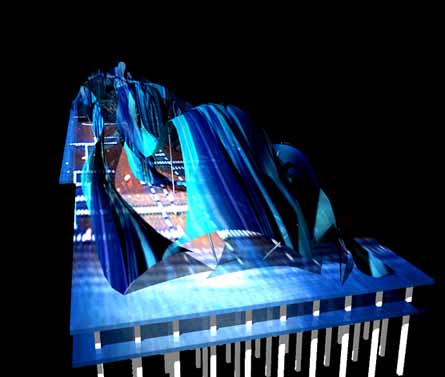
Among my favorite quotes is one from Paul Virilio, while being interviewed by Andreas Ruby (who also had some words of wisdom in the wording of his questions):
“And there is no point why such virtual model would be confined to design purposes only. You would more than likely end up using it to also “live” in that space.”
“Centuries ago, matter was defined by two dimensions: mass and energy.” “Today there comes a third one to it: information…. Today, information counts more than mass and energy. The third dimension of matter takes the place of the thing itself.” “Any kind of matter is about to vanish in favor of information.”
“Architecture is just about to loose everything that characterized it in the past. Step by step it looses all its elements. In some way, you can read the importance given today to glass and transparency as a metaphor of the disappearance of matter. It anticipates the media buildings in some Asian cities with facades entirely made of screens. In a certain sense, the screen becomes the last wall. No wall out of stone, but of screens showing images. The actual boundary is the screen.”
William Mitchell, who passed away just last month, contributed an essay to “The Virtual Dimension: Architecture, Representation, and Crash Culture,” published 12 years ago, and had this to say:
“Bits also change the ways that buildings work. Works of architecture function as both shelter and symbol, and the introduction of digital technology opens up news ways to perform the symbolizing role. The resulting restructuring of a building’s basic organization compares to that which resulted when artificial light appeared as an alternative to natural light.”
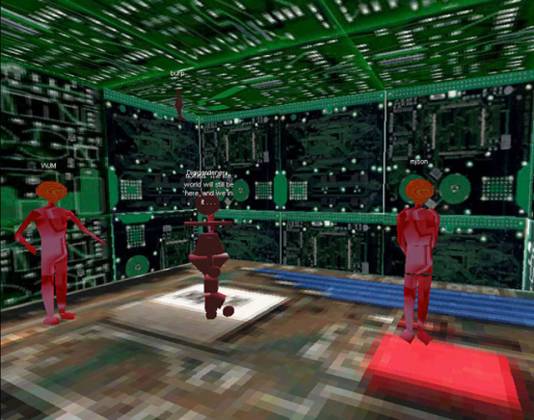
Professor Mitchell goes on to say, “Electronics now rule. The architectural profession can face this new condition as an increasingly irrelevant, resistant stump – insisting on materiality and practicing a nostalgic modernist revivalism while potential clients vote with their feet. Theorists can take solace in Heidegger, and construct loftily disdainful texts about all things technological. But it is more productive, and certainly a lot more fun, simply to retire the exhausted dogma of architectural composition and construction as our world is rewired.”

There are so many incredible quotes and observations in these texts, that I couldn’t possibly cover them here. But I have an open question that nags me every time I pick up one of these books. Where are these theorists and architects today who contemplated the coming advent of cyberspace so many years ago? I’m not as interested in what they would build in SL (although that would be a hoot..) – I’m more interested in what they think of all of this.
Where is John Beckmann, Stahl Stenslie, Margaret Wertheim, Claudia Springer, Michael Heim, Mark Taylor, Peter Anders, Stephen Perrella, Stan Allen, Ben van Berkel, Caroline Bos, Lars Spuybroek?
For the love of God, where is Asymptote?!? Why aren’t they building, or writing about cyberspace? Are they? If so, can someone give me a SLurl?

Turning to “Architects in Cyberspace,” published by A.D. – also 12 years ago, I wonder, where are the many architects and theorists who provided case studies for this volume? Where is John Frazer and Manit Rastogi? Where is Karen Franck or Marcos Novak, who had such brilliant insights into these coming digital environments? When reading Roy Ascott’s essay “Technoetic Structures,” I can’t help but to wish these concepts could be realized now that we actually have such a robust and interconnected prototype of cyberspace to play with? So many of the illustrations in these books are static renderings from modeling software like 3D Studio – intended to be a glimpse into what someday might be. Now that its here – where have they gone?

Many of the projects published in “Hybrid Space: New Forms in Digital Architecture” also published 10 years ago, are begging to be realized and explored in today’s virtual environments. Imagine exploring Stephen Perrella’s “hypersurfaces” in Second Life or Unity3D, or a guest lecture by someone with Oosterhui Associates held from within one of their “body-buildings” or “performing” structures that can be manipulated on a website, where “players” can modify the building through a real-time evolution (Hybrid Space, page 73).
I want to be absolutely clear about this.. nearly every single ‘futuristic’ cyberspace project imagined in these books could be built in Second Life right now. In fact, I challenge anyone to find a project shown in any of these books that can’t be built or prototyped in SL right now.
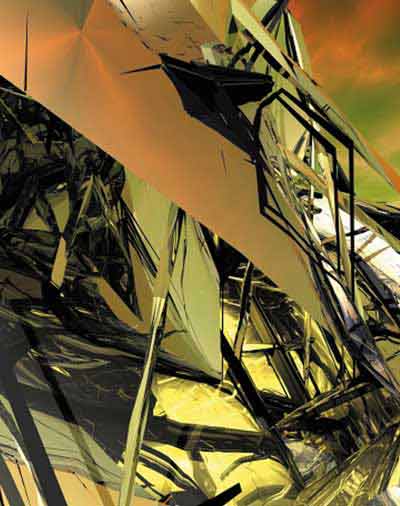
Just look at Marcos Novak’s “liquid architecture” and “transarchitectures” that “confront and explore the integration of physical and virtual spaces with aspects of algorithmic unfolding, meta-data visualization and navigable computational environments.” Isn’t this already happening in SL? Where is Marcos now? More importantly, has Marcos seen places like Second Life? What does he think about it? What are his criticisms and suggestions for further exploration?
Here are a few guesses as to why we might not be able to find architectural cyberspace theorists. If you can think of any more, post them in comments and I’ll add them to the list:
- They don’t recognize it. Cyberspace may have happened exactly as they said it would, but it all depends on how they are exposed to it. Even if they stumble onto the most incredible screenshots or machinima ever made in SL, they may not recognize it as cyberspace, or realize how much it shares in common with their conception of cyberspace
- They bought into earlier platforms, concepts or modalities, and are unable or unwilling to acknowledge the utility and community currently working and migrating between a variety of available platforms like Second Life, OpenSim, Blue Mars, Unity, etc. If they don’t share the exact standards from which they imagined cyberspace would evolve, they won’t play.
- They’re already there, but we don’t recognize their names. Thanks to the ridiculous Second Life naming restrictions, you might do a double-take next time you’re talking to a furry with a name like “Pumpernickel Sassafras.” He might just be a world famous architectural theorist… yeah, I’m sure that’s it..
- They’re authors, theorists and academics, not architects. They write books, not design virtual buildings. Maybe the ones doing the writing were mostly theorists – not practitioners. Perhaps they lack the ability to execute a project in cyberspace, even if they wanted to. But even if this is the case, I’m still more interested in what they think about all of this, as much as what they would personally build.
- Inconsistent jargon. The vast majority of earlier works on the subject refer to 3D online space as ‘cyberspace, hyperspace, digital space, hybrid space, and so on. The terms we most often use in the SL-derivative discussions are ‘virtual worlds’ – and perhaps the 3D web, immersive internet, etc. There is a distinct chance that many more people would be able to find and experiment with Second Life or OpenSim – but they just don’t recognize our terminology. We may expect widespread awareness simply because SL has been shown in print media, television programs and movies, yet rarely do those experiences result in an ‘aha’ moment on behalf of the viewer. Most people won’t run to their computer and download Second Life, and even more won’t care.
- Not as sexy as they imagined. It could be that they thought cyberspace would somehow be more sexy, or sophisticated – yet any given random exposure to Second Life could easily be something far more pedestrian than the theory-driven floating clouds of information fog they imagined cyberspace would be.
- We can’t find them. Their work can’t be Googled. Unfortunately, it is quickly becoming the case that if it can’t be Googled, it didn’t happen. Even the most clever Google alerts and searches won’t turn up mention of these works. Even if their writings were digitalized, the terminology is different – and still may be overlooked.
- They can’t find us. They’re unaware that places like Second Life exist. I still haven’t met another architect in real life who has heard of Second Life… Plus, even though I was ready and waiting for cyberspace since the late 90’s, I was dissapointed to discover that by the time I found out about Second Life, it was already 3 years old.
- They’ve moved on. Cyberspace took longer to happen than they expected, and – 20 years later – they’ve moved on to other things.
- They’re afraid. It was much easier to conjecture what cyberspace would be like before it happened. Now that its here, it requires a bit more bravery and in-depth research just to analyze the volumes of work already created, much less speculate as to where its all going, and what it all means.
[update: Another factor just occurred to me after posting this, that in the early 90’s, when so much of the best theory around architecture in cyberspace was written, much of the world was in a relatively deep financial recession. Could it be that the lack of ‘real world’ work enabled many architects to devote more time to writing and theoretical discourse? If that’s the case, it begs the question – why, in the midst of the Great Recession we’re in now, isn’t the same thing happening? What are all of the laid off architects doing with their newfound free time?]
I’m not sure that it matters why they’re not here, or if they will ever come. But it doesn’t stop me from remaining perpetually curious as to why this is the case. If they’re aware of it, then what are they waiting for? I don’t mean that in a pejorative sense – but seriously, what characteristics of cyberspace are they holding out for? What would the perfect cyberspace environment look like in their minds? How would it differ from what SL or OpenSim is today? What would that ideal environment look like? Isn’t it good enough that millions of people have experimented, or are currently experimenting in platforms like Second Life, OpenSim, Blue Mars, Unity, Unreal, and more? Will there ever be a virtual environment that will be ‘just right’ for theorists of architecture in cyberspace to revisit the topic once more?
As we continue to experiment with architectural concepts in cyberspace, we will necessarily do so while standing on the shoulders of giants. The only problem is, the giants have no idea we’re there.